
The Gates Story
An idea, a milling machine and a garage
In 1969, Elwyn Gates set out to solve a simple underwater photography problem. That experiment became the beginning of more than five decades of innovation in underwater imaging.

1969
A problem worth solving
Men walked on the moon. The New York Jets won the Super Bowl. Woodstock defined a generation. Elwyn Gates changed the world of underwater imaging.
Like many inventions, it began with a desire: to photograph small marine creatures at close range using a Nikonos III underwater camera. At the time, the Nikonos 28mm and 35mm lenses could focus no closer than approximately 2½ feet.
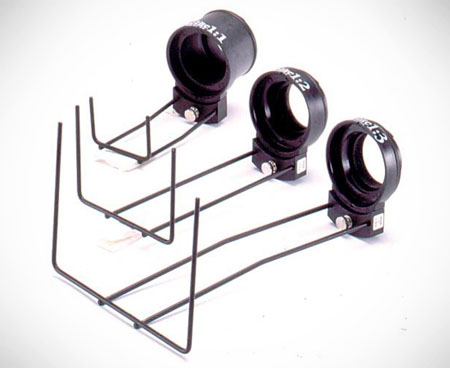
Elwyn experimented first with water-contact and sealed close-up lenses. His third attempt used a plastic tube placed between the camera and lens and held together with rubber bands. In classic Elwyn fashion, the improvised device worked remarkably well.
The First Product
The Nikonos Extension Tube
To refine the device, Elwyn took an old Nikonos camera and placed a ground-glass plate at the focal plane, with a Plexiglas window behind it. This allowed him to determine the precise focal point for any lens and extension configuration.
The Nikonos Extension Tube Kit was born.
More than 100,000 Nikonos Extension Tube Kits were sold before the product was finally phased out in 2003.
Expanding the Idea
Connectors, strobes and the first housings
The next Gates product was a strobe connector. Third-party strobes were available for Nikonos cameras, but the connector still had to be purchased from Nikon. Elwyn developed a simple, reliable and affordable alternative, putting Gates into the underwater connector business. Thousands upon thousands were produced.
The first Gates underwater housing was made from Plexiglas, a material that was relatively easy to machine, assemble and seal. Acrylic remains widely used for housing windows and hobbyist housings today. Elwyn built housings not only for cameras, but also for strobes and light meters.
“I would spend weeks building a housing that did not pay very well for the time it took to do it. With experience, I started getting more people to hire me to do stuff for them.”

The 1980s and 1990s
Recognition and a changing industry
The 1980s and 1990s brought experience and new opportunities. A Gates Sony Betacam housing earned Elwyn an Emmy for Technical Achievement in 1987 for Spirit of Adventure: Beneath the Sea, the Galapagos. Stan Waterman, Bob Sloan and Howard Hall were members of the production crew.
The Sony Betacam also signaled a shift toward increasingly compact camera systems, including the Sony TRV101 and PC7 Handycam in 1996.
Against the advice of friends, Elwyn designed a small aluminum housing with simple ports for the PC7. It became the best-selling housing model in Gates history, selling hundreds of systems and prompting other manufacturers to follow with compact housings of their own.
2002 to Today
Building on a bulletproof reputation
After more than three decades, Elwyn and Ann Gates sold the company to John and Karen Ellerbrock in 2002.
Building on the reputation established by its founders, Gates today serves professional cinema, broadcast, research, military and other demanding underwater markets.
Don’t take a chance…take a GATES!
Trusted in the Field
Recent testimonials
I have been using Gates Underwater Products for the whole of my professional career, filming wildlife and presenters underwater all over the world. Gates is the market leader for good…
As a professional underwater camera operator and DOP in the film and television industry I need the best underwater housing money can buy. I know Gates housings are very well…
"Underwater filming is a key part of our business; it’s also my ‘first love’ in filmmaking. In addition to shooting internationally for specific projects, I spend as much time as…
I've never even thought twice about whether my ProExplore housing is up to the challenges that I throw at it. From being tossed in and out of a boat on…